Trinity: Black Dogs, Ancient Forts and a Zoo That Put Trinity on The Map
Posted on

Trinity: Black Dogs, Ancient Forts and a Zoo That Put Trinity on The Map
Trinity might be one of Jersey’s quietest parishes, but its history is anything but.
Today it remains one of the most rural parts of the Island. A landscape of green lanes, scattered farms, fields and valleys stretching to the cliffs of the north coast. In fact, according to the 2021 census, Trinity had one of the lowest population densities in Jersey.
But hidden amongst the green lanes, where we pull over to avoid colliding with tractors, are prehistoric burial sites, Iron Age remains, centuries-old manors, stories of French invasion, Civil War politics, smugglers, a rather terrifying supernatural dog, and of course, one of the world’s best-known wildlife conservation organisations, the latter of which particularly continues to make me proud to be a Jersey Bean.
So there’s quite a lot going on for somewhere that feels so peaceful and green.
Before we get into the history, there is something unusual to point out because, unlike most of Jersey’s parishes, it isn’t named for a patron saint. Instead, the parish and its church are dedicated to the Holy Trinity – the Christian doctrine of God as the Father, Son and Holy Spirit.
With such a religious focus, you’d think there would be solid records around the Church itself, but there isn’t. The exact date the Church was founded is uncertain. What we do know is that, like many of Jersey’s churches, the building developed gradually throughout the medieval period rather than being constructed in one simple build.
And for centuries, the church sat at the centre of parish life.
And of Island life too actually… during the English Civil War, after Sir George de Carteret returned to Jersey in the later part of 1643, the States relocated and met inside Trinity Parish Church on 24 November, where de Carteret was sworn in as Bailiff and Lieutenant-Governor.
In other words, for one pretty significant moment in Jersey’s history, the business of government was uprooted and moved to take place in Trinity Church, which now makes the average parish meeting seem slightly less dramatic.
Only a few years later in 1648, the church had another dramatic encounter when its tower was reportedly destroyed by lighting during the Great Storm… maybe this was a sign about keeping politics and church-life separate?
But Trinity’s story begins thousands of years before any parish church stood there.
Archaeological evidence from around les Platons and Rozel shows people using this part of the Island long before the medieval parish existed.
At Le Hougue des Platons, excavations uncovered cremated human remains, pottery and evidence of a funeral pyre.
Nearby, Le Câtel de Rozel appears to have had an even longer history. Archaeologists believe a structure may have existed there during the Neolithic or Early Bronze Age, before the site became an Iron Age fort.
Finds from the wider Rozel area also include Iron Age coin hoards with Roman coins giving us a glimpse of communities that were far more connected with the wider world than we might imagine when gazing across Trinity’s fields today.
The landscape itself is also pretty dramatic.
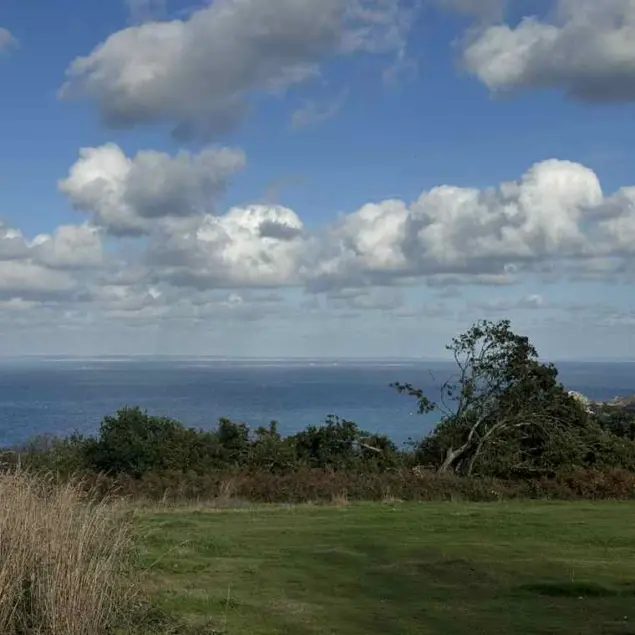
Trinity stretches from Jersey’s central-northern countryside right out to the rugged north coast. Les Platons, the highest point in jersey, lies within the parish, while down below sits Boulay Bay, surrounded by some of the Island’s steepest coastal scenery.
And Bouley Bay has accumulated more than its fair share of stories.
In 1549, French forces landed there during an attempted invasion of Jersey. They were defeated, although Lieutenant-Bailiff Jurat Helier de la Rocque was killed in the action.
The attack helped show how strategically important this part of the coastline was. By 1596, a cannon had been stationed at Bouley Bay to ward off those with grand ambitions to take over Jersey. Neighbouring parishes collaborated and became responsible for maintaining the crucial defences.
Fortification of the area continued during later periods of tension with France, and the Trinity coastline again formed part of Jersey’s defensive network around the time of the Battle of Jersey in 1781.
But military history probably isn’t what most Islanders associate with Bouley Bay.
That honour belongs to a very large dog.
Lé Tchian du Bouôlay – the Black Dog of Bouley Bay – is one of Jersey’s most famous legends.
According to tradition, an enormous black dog with glowing eyes roamed the cliff paths around the bay at night, sometimes dragging a chain behind it. (I have reminded my dogs they are lucky that they aren’t chained up outside at night, but they do still seem to have glowing eyes when they spy a piece of chicken…).
Depending upon which version of the story takes your attention, seeing the dog could mean a storm was brewing, warn of death, frighten unsuspecting travellers or – rather more helpfully – guide people to safety.
There was even said to be a particular cave or hollow known as Le Trou du Tchian – the Dog’s Hole – where the creature lived.
One explanation is considerably less supernatural.
Smugglers may have encouraged the Black Dog stories because a reputation for ghostly hounds roaming the cliffs after dark was probably an effective way of discouraging people from wandering down to Bouley Bay while contraband was being unloaded.
To be fair, if they were unloading chicken-flavoured contraband my dogs would not be deterred whatsoever… (and I probably wouldn’t either if it was nice shiny cargo or handbag shaped…)
The legend became so established that it entered local language and culture. Someone arriving somewhere frightened or shaken was reportedly asked whether they had been bitten by the Dog of Bouley. An inn known as the Black Dog Tavern was even located above the bay at one point.
Trinity’s human residents have left some pretty remarkable legacies as well.
For much of its history, the parish developed around farms, manors and scattered settlements rather than around one large village.
Trinity Manor was at the heart of the Fief de la Trinité and passed through several important Jersey families over the centuries, including the de St Martins, Lemprières and de Carterets.
Some of the stories attached to these estates are almost as memorable as the folklore.
Diélament Manor, for example, is said to have passed to the Lemprière family in the early fifteenth century for the not-inconsiderable price of 1,000 cows and two pipes of Gascony wine.
There is a sentence you don’t get to write very often (if only this is all it took to buy a sprawling Manor today…).
Trinity Manor itself changed considerably in the twentieth century after Athelstan Riley acquired it in the early 1900s and undertook an extensive restoration, creating much of the manor we recognise today.
But another Trinity manor was about to become considerably more famous.
In 1959 Gerald Durrell established Jersey Zoo at Les Augrès Manor, where I spent many good days during my primary school years where we seemed to embark on a visit to the Zoo at least once a year to complete some sort of animal-focused project (although I still get confused on which animals are mammals etc…).
Durrell had already spent years travelling and collecting animals, but his ambitions in Jersey went far beyond creating another conventional zoo. His growing focus was conservation and the protection of species threatened with extinction.
The Jersey Wildlife Preservation Trust followed, later becoming the Durrell Wildlife Conservation Trust.
From a manor in one of Jersey’s quietest rural parishes grew an organisation with an international conservation mission.
It is difficult to think of anything that has changed Trinity’s profile more dramatically.
Gerald Durrell became one of the Island’s most famous adopted residents, while his wife Lee Durrell has continued to play an important role in the conservation work associated with the zoo.
And they are far from the parish’s only notable connections.
Artist and illustrator Edmund Blampied (1886 – 1966) lived at Les Augrès and attended Trinity School as a child, while engineer and inventor Lyndon “Don” Charles Pallot (1910-1996) was born and educated in the parish. His collection of historic engines, tractors and vehicles would eventually become the Pallot Steam, Motor & General Museum.
Yet despite all of this – prehistoric settlements, invasions, political drama, wealthy seigneurs, ghost dogs and globally recognised conservationists – Trinity has somehow retained much of the character that has defined it for centuries.
Agriculture remains an important part of its identity. Farms and fields still dominate much of the landscape. Bouley Bay, once closely tied to maritime life and coastal defence, has become somewhere Islanders go for brisk swims, mysterious dives, taking in the speed of the hill climb and simply to enjoy one of the most dramatic stretches of coastline in Jersey.
Much of the surrounding countryside and coast is now protected for its environmental or heritage value too.
And perhaps that is what makes Trinity so interesting.
At first glance, it can seem like one of Jersey’s quieter corners.
But scratch beneath the surface and you find thousands of years of occupation, the Island’s highest point, ancient forts, medieval fiefs, French invasion, Civil War politics and one rather infamous supernatural dog.
Then, in the middle of all that history, a manor house became the headquarters of a conservation movement whose work would reach far beyond Jersey.
For a parish so often characterised by its peace and countryside, Trinity has managed to leave a surprisingly large footprint on the world.
Sources and Further Reading
Full Sources Available Upon Request
Government of Jersey
Jersey Heritage
Jersey Archive
Jersey Deanery
Trinity Parish
Durrell Wildlife Conservation Trust
Pallot Steam, Motor & General Museum
Parish of Trinity – Tattler, Issue 42, Spring 2026
Prehistoricjersey.net
Jerripedia